Exhuming Adventures - Ker Nethalas: Into the Midnight Throne - Part I
Hey beautiful people! The family and I are back from vacation, and the spooky season is upon us! We've got Ker Nethalas on the table, prepped and ready.
I want to start off by saying Ker Nethalas: Into the Midnight Throne holds a special place in my heart. It was my gateway game into solo RPGs, and it has helped me mentally escape and decompress in my downtime. I've played and learned a lot in the process and from the community.
Since I have already played the game, I won't be able to see it as a completely neutral observer. I genuinely enjoy what Ker Nethalas is aiming for. My main question is whether the Gravebound Edition conveys that experience clearly enough for someone new to the game, and whether its procedures, tables, and bookkeeping help create decisions that feel meaningful and rewarding.
This first part examines the book, establishes the setting, creates a character, and defines what the first session must test.
As we play through this series, I'll be using some unconventional methods to report and play, which I will list and link:
🔗 - I will be using Lonelog to chart our sessions and adventures. This will log our actions, questions, mechanics, and results. You can always refer to the following chart.
- @ for player actions
- ? for oracle questions
- d: for mechanics rolls
- -> for oracle/dice results
- => for consequences
🔗 - Foundry VTT and my module, The Vaelorian Archive, to save, map progress, and contain our rolls.
🔗 - Overseer Studio, a digital GM screen infinite board, which allows me to add snippets from books and arrange everything on one screen.
🔗 - And of course, Ker Nethalas in PDF format to be sure we are up to date on our information. Version 1.2 as of writing this. I do physically own most of the Blackoath catalog.
You don't need to use any of these digital tools to play. I personally find them helpful for keeping track of information and remembering the details of a campaign.
If you have a copy of Ker Nethalas: Into the Midnight Throne in print or PDF, you're most welcome to join in. Feel free to create your own Survivor, make your own choices, and compare your rolls and discoveries with mine. I'll include page references when helpful and use LoneLog notation to clearly share outcomes.
The Body of Evidence
There's a tempting promise that a single survivor, dumped in a vast necropolis, can run a full campaign without needing a Game Master. It's a promise worth exploring.
I'm excited to bring the Ker Nethalas: Into the Midnight Throne - Gravebound Edition to the table and take a close look at what makes it tick. We'll see how its solo procedures work, discover its brightest ideas, and identify what might keep it on your to-do list for later. A final decision should come only after trying it out in actual gameplay. For now, consider this the first step in our exploration. Let’s gown up, double-glove, and discover what makes Ker Nethalas tick; I am ready to assess.
Our examination will go beyond just the rules. I’m eager to see how well the book guides you through its procedures, how easily I can find answers as I play, and whether all those moving parts help create a fun atmosphere or make it feel overwhelming. A deep game might require some effort, but that effort should always lead to rewarding moments around the table.
-The Book-
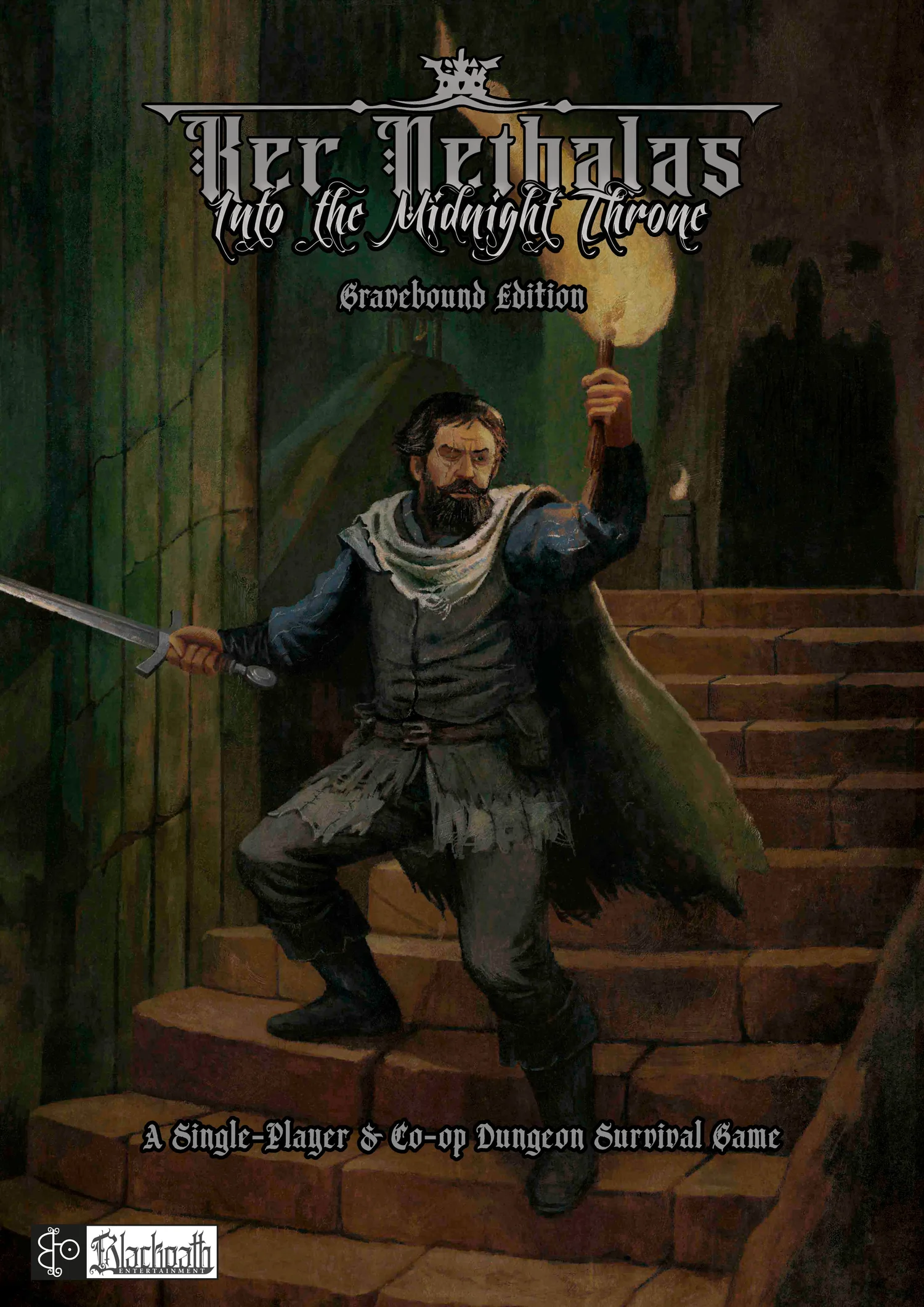
Ker Nethalas: Into the Midnight Throne is a solo/co-op dark fantasy dungeon crawler written by Alex T. and published by Blackoath Entertainment. The Gravebound Edition, the game's updated rule set, of course, provides a complete rules engine, character creation, exploration procedures, combat, adversaries, equipment, and the material needed to procedurally create the underworld as you enter each room and corridor of an enormous subterranean necropolis.
The book itself is physically in A5 format, popularly available on Drivethru RPG and Amazon (US). It is beautifully illustrated and each piece of art within the book is truly capturing the games setting.
This is not a light role playing game. You can expect character management, tactical decisions, repeated table lookups, mapping, and resource pressure. It's the game's DNA, and for some, might be an obstacle. The book offers a great deal. A new player just needs to turn that information into a usable table procedure.
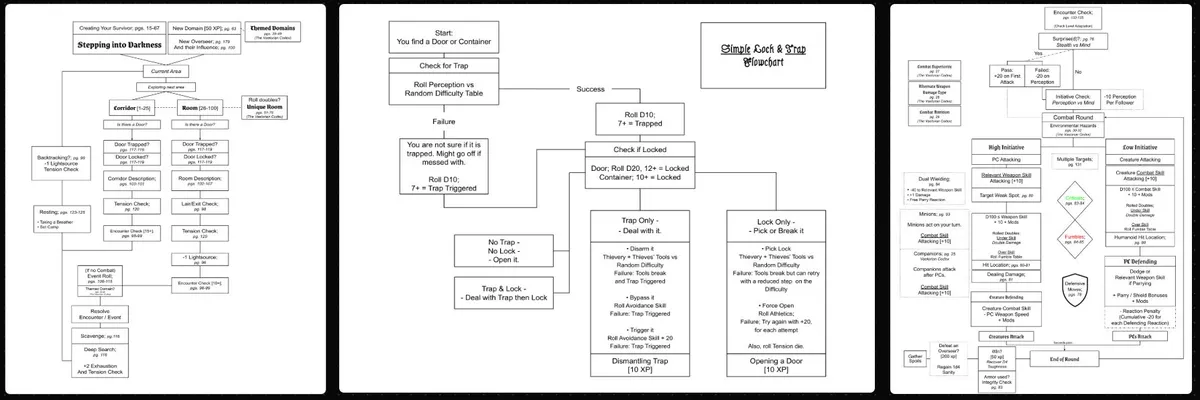
Luckily, Alex provides his own, and folks have made their own flowcharts. I've also played enough of the game to revamp some old flowcharts for the Gravebound Edition, and I've included some tidbits from the expansions. You can find similar stuff on the Blackoath Discord under Game Resources.1
Flowcharts are a helpful shortcut. Procedural games can really benefit from having a condensed reference to quickly recall rules once you get familiar with them. What truly matters is whether the flowchart makes it easier to remember a clear process or if it helps find information that’s tricky to spot in the book. I’ll pay attention to how often I need to pause the game to look up something, how fast I find the information, and whether the same rules keep making me search again and again.
Digging in, try not to memorize everything at once. Take time to understand the basic percentile check, read the description of each Skill and Mastery, and flesh out a Survivor as you go on. You will get used to the exploration sequence, and after the first few rooms, you will have slowly learned the rest. The rules become steadily clearer as we come across problems like a locked door, a dwindling light source, or something in the dark that wants you dead.
-The World-
As Above, So Below. The world within the game is massive in itself. Alex T. has already laid out that out. Between games, Alex happily creates more lore, adding extra layers.2 Above Ker Nethalas sits Veldonia, the capital of the Alderworth Kingdom, a city slowly decays under the weight of its former glory. Ordinary citizens endure poverty, hard labor, and a justice system that treats vagrancy, blasphemy, or political defiance as serious crimes.
Beneath those streets lies Ker Nethalas, once the capital of the necromantic Vaelorian Ascendancy. Its buried passages extend far beyond the city walls. Obsidian Wardens guard the known entrances, keeping what hides in the dark at bay. The city also uses parts of the underworld to dispose of trash and condemned people. The Crimson Coliseum, another place where the condemned could face their fate, is connected to the depths, with rumors that some of its monsters are hauled directly from them. This coliseum is featured in another great game by Alex T. 3
These dominions are monuments to fallen greatness. Both are ruled by the remnants of old power and sustained by the suffering of people deemed disposable.
-The Player Character-
Every corpse has a story; let's begin by creating ours. Here, we play as a Survivor: a character who has been hanged for a crime, whether or not one was committed, and then cast into a dumping pit. This is not some basic-ass heroic class dumped into a dungeon. Your character is defined by how they manage to stay alive.
So we just survived an execution; before anything else, we choose our name, gender, age, and appearance. Here I dedicate my first exhumation to my late friend, Nipz.

| Name: | Glaemor |
|---|---|
| Gender: | Female |
| Age: | 37 |
| Appearance: | Short, Pale Skin, Brown Hair, and Green Eyes |
Now we gain our first level, and we need to identify the crime we are accused of.
? Which Crime Were You Accused Of? [D20] -> 8 - Treason
"They labeled it treason because revealing the truth would have humiliated powerful men. The trial was over in less than an hour. No witnesses testified in my favor, no evidence was shown, and the verdict was decided before it even began. By sunset, I was standing beneath the gallows as a herald read aloud crimes I never committed, to a crowd eager for an execution. I recall the rope tightening around my neck, and darkness took me. However, I don’t remember falling onto a pile of cold bodies. When I opened my eyes, I saw light coming from the top of the pit. The city had declared me dead... Ker Nethalas will decide if I remain so."
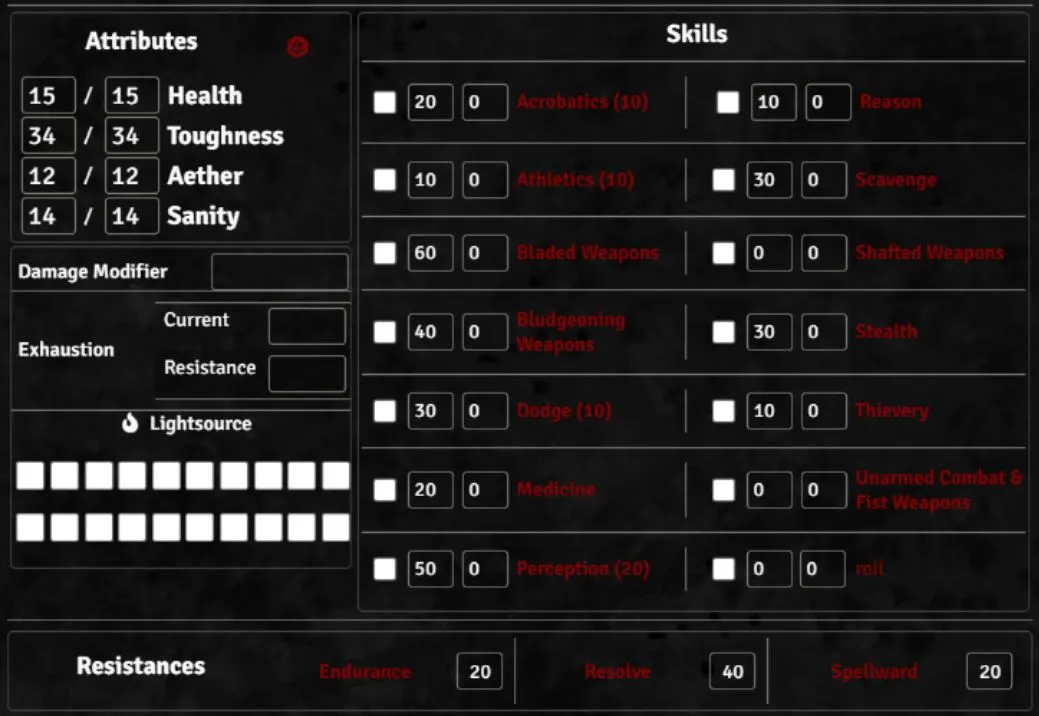
💀 - Attributes
There are five attributes that form the vital signs of every Survivor in Ker Nethalas.
Health represents serious physical injury. While toughness can reduce some of the damage during an encounter, damage that affects health is significant and hard to recover from. If health drops to zero, our Survivor is deceased.
d: Starting Health is [D6+10] -> 15
Toughness reflects our ability to handle punishment. Think of it as a protective buffer against damage, which you can usually recover from more easily than Health. When Toughness drops, it’s a sign that the dungeon is kicking our ass.
d: Starting Toughness is [3D6+20] -> 34
Aether is the heart of our Mastery Abilities. It's both a vital resource and something else to manage. A Survivor might have a powerful ability, but using or maintaining it can decrease what's left in a situation. Luckily, Aether is replenished upon entering a room. So, choosing when to spend Aether is all about timing, not just raw power.
d: Starting Aether is [D6+8] -> 12
Sanity measures your ability to withstand the supernatural horrors of Ker Nethalas. Frightening creatures, unnatural discoveries, and the living darkness can gradually chip at it. A Survivor may remain physically capable while becoming increasingly vulnerable to the necropolis's psychological weight.
d: Starting Sanity is [D6+10] -> 14
Exhaustion measures our physical and mental strain. Abilities, travel, deprivation, and other demanding actions can increase it. As Exhaustion builds, your Survivor becomes less effective, and letting it climb too high can be fatal.
New characters begin with 0 Exhaustion.
These attributes add to the survival challenges characters face. Someone can have plenty of Health, but might still be close to mental collapse. A brave fighter might survive a fight only to realize that the Exhaustion they gained has made pressing on harder.
Taken together, these five Attributes establish that death is not the only form of failure. Toughness measures the punishment Glaemor can absorb immediately, while Health records lasting physical danger. Aether determines how freely she can use her defining powers. Sanity and Exhaustion threaten her even when combat has gone well.
💀 - Skills
Skills are all about the practical actions our Survivor takes during exploration and combat. When an uncertain action has important consequences, you’ll generally roll a d100 and try to get a number equal to or below the relevant skill.
The skill list reflects what the game emphasizes. Combat skills show how well you can handle different weapons. Acrobatics, Athletics, Dodge, and Stealth relate to movement and avoiding dangers. Perception and Reason help you spot threats and understand what you find. Medicine manages injuries, while Scavenge and Thievery help you gather useful resources from locked, trapped, or abandoned places.
These skills aren’t just background details. They really affect how you approach the dungeon. A perceptive scavenger might find supplies that others miss. A clever thief can usually get past a locked door without attracting trouble. A heavily armed fighter might win direct fights easily but could struggle with stealth, investigation, or being resourceful when the situation calls for it.
Our Survivor starts with the following: - +60 to one Weapon Skill. - +40 to a second Weapon Skill. - +30 to three Skills. - +20 to two Skills. - +10 to three Skills
Of course, you can't assign these to the same Skill. Make sure to read each description to get a sense of a character. You might find yourself going back and making changes, so that is perfectly fine.
Moving forward, I chose:
| Added | Skill | Total |
|---|---|---|
| +60 | Bladed Weapons | 60 |
| +40 | Bludgeoning Weapons | 40 |
| +30 | Stealth | 30 |
| +30 | Scavenge | 30 |
| +30 | Perception(20) | 50 |
| +20 | Dodge(10) | 30 |
| +20 | Medicine | 20 |
| +10 | Athletics(10) | 20 |
| +10 | Thievery | 10 |
| +10 | Reason | 10 |
This allocation really helps Glaemor establish a clear identity. The Bladed Weapons offer reliable offense, while the Bludgeoning Weapons give her a versatile option for different damage types. Skills like Perception, Scavenge, and Stealth will complement the Tracker and Duskblade build I have in mind for this Survivor. Also, Dodge and Medicine add useful protection, especially when careful planning doesn't go as expected.
💀 - Resistances
Resistances will reflect our Survivor's ability to endure threats that can't always be addressed with regular actions.
New characters begin with 40 points in one Resistance and 20 points in each of the other two.
Spellward protects against incoming magic and supernatural effects. If an enemy tries to harm, corrupt, or control our Survivor through magic, Spellward can give us the defense we need.
Endurance will reflect our Survivor's physical resilience. We'll rely on it when facing threats like poison, disease, harsh environments, or other challenges that test their physical strength.
Resolve stands for mental strength and willpower. It's tested when our Survivor faces fears, horror, coercion, or effects that threaten their Sanity and self-control.
This distinction really helps clarify things. Skills usually show what our Survivor actively tries to do, while resistances reveal what they can handle during dungeon challenges.
| Added | Resistance |
|---|---|
| 40 | Resolve |
| 20 | Endurance |
| 20 | Spellward |
I gave Resolve the highest score because physical durability is already reflected in stats like Health, Toughness, Dodge, and Medicine. Protecting Sanity is more challenging through regular actions, and even a physically healthy Survivor can be overwhelmed by the mental strain of the necropolis.
💀 - Masteries and Abilities
Character identity truly shines through in your Masteries and Abilities. Think of building your character not just as improving a single weapon skill, but as shaping how your Survivor approaches the game. It can focus on direct combat, mobility, summoning minions, or battlefield control. Aether adds an extra layer, creating a second economy based on what makes your Survivor special.
This is what makes the game so thrilling! While procedural dungeons might make each trip feel similar, your choices in character building give every adventure its own unique flavor. For example, the same room can feel very different depending on whether you're a cautious scavenger, a heavily armored fighter, or an occultist relying on Aether.
Remember, character creation can become a fun hobby on its own. That’s fantastic, especially with the addition of expansions! But don’t let optimization overshadow the joy of playing. For your first descent, it's often best to pick a pregenerated Survivor from the Quickstart4, or stick with a clear concept rather than spending hours perfecting a meta-breaking build.
For Glaemor, I chose Tracker and Duskblade.
Tracker gives Advantage on Perception and Scavenge checks through its Survivalist feature. Its first Ability, Cook Forager, creates a Cooking Ingredient whenever Glaemor succeeds at Scavenging. These benefits should help her spot threats and extend her resources for longer expeditions.
Duskblade offers Silent Strike, allowing Glaemor to target a precise Hit Location without Disadvantage when attacking an unaware enemy. Its first Ability, Poisoned Blade, uses 3 Aether to inflict Poisoned (1). This provides a great way for her to weaken tough opponents instead of relying solely on direct weapon damage.
On paper, these Masteries work well together. Tracker helps Glaemor notice danger and gather resources, while Duskblade rewards her for approaching combat carefully. The one challenge is Stealth. With only a 30 percent starting chance, the stealth aspect may be less reliable than the scavenger side. Her first expedition will show whether this combination works as a cohesive build or just sounds good during character creation.
-The Gameplay-
Ker Nethalas uses a simple percentile system. To see if you succeed, just roll a d100 and compare your result to the target number, usually aiming to roll equal to or lower. This gives you a quick glimpse of your chances. You can also adjust the target with various modifiers.
Features like Criticals, Fumbles, Advantage, Disadvantage, and different Defensive or Reactive options add variety and excitement without overcomplicating the core rules.
At its heart, Ker Nethalas is built around the Domain exploration loop: entering a new area, generating or revealing what's ahead, updating your map, resolving what's there, managing your resources, and deciding whether to search, rest, retreat, or push forward toward the Overseer.
For solo players, keeping this loop going is especially valuable. Since you're handling the role of player, referee, record keeper, and audience all at once, having a quick and clear way to resolve actions allows you to focus more on decision-making and storytelling.
And it’s not just about mechanics. Combat involves thoughtful choices about actions, reactions, damage types, armor, weapon qualities, conditions, and enemy behavior. The system truly shines when you see it as a tactical engine, not just a framework for narration with some rolls sprinkled in.
A typical adventure unfolds with a familiar rhythm:
- Enter or keep exploring a Domain.
- Discover or reveal the next room or corridor.
- Mark the area on your map.
- Deal with doors, hazards, discoveries, or encounters.
- Keep track of light, Tension, resources, and conditions.
- Search or scavenge, knowing there might be some risk involved.
- Decide whether to press on, take a break, set up camp, or retreat.
- Survive long enough to find and face the Domain’s Overseer.
The tables show what’s inside the necropolis, but it’s in those decision points that the game really comes alive.
For Glaemor’s first adventure, I’ll be exploring the initial First Domain found in Chapter VII, Stepping Into Darkness. Its map, doors, and exit are already set up, while the room content and potential encounters follow many of the game’s usual rules. It also includes a smaller Combat Encounters table, specifically designed for this opening area.
This setup makes the First Domain a guided introduction instead of a completely random adventure. It allows me to test combat, scavenging, Tension, resource management, and the exploration flow without having to create an entire Domain from scratch. This distinction is important: the first session will help me see how well the book teaches gameplay, but it won’t fully evaluate the typical Domain-generation process. Glaemor still needs to make it through a later Domain for a full assessment of that part of the game.
Glaemor is all set for her first adventure! During this session, I'll happily keep an eye on how long it takes to get everything set up, how often I need to reference the book, and whether Tracker really helps me explore better. I'll also see if Duskblade can create an advantage before the fight starts. Plus, I'll note how long the first battle lasts and if things like light, Tension, and resource pressure influence my choices. I'm excited to see how everything unfolds!
The final question is simple: when the session ends, will I want to open one more door?
In Part II, Glaemor steps into her First Domain, and we'll use the book to transform everything set up here into real play, bringing the scene to life.
Feel free to join the Blackoath Discord! Tell em' Grotesque sent ya!
See you in a couple of weeks. Stay Brutal.
Like what you see? Drop me a skull!
Footnotes